
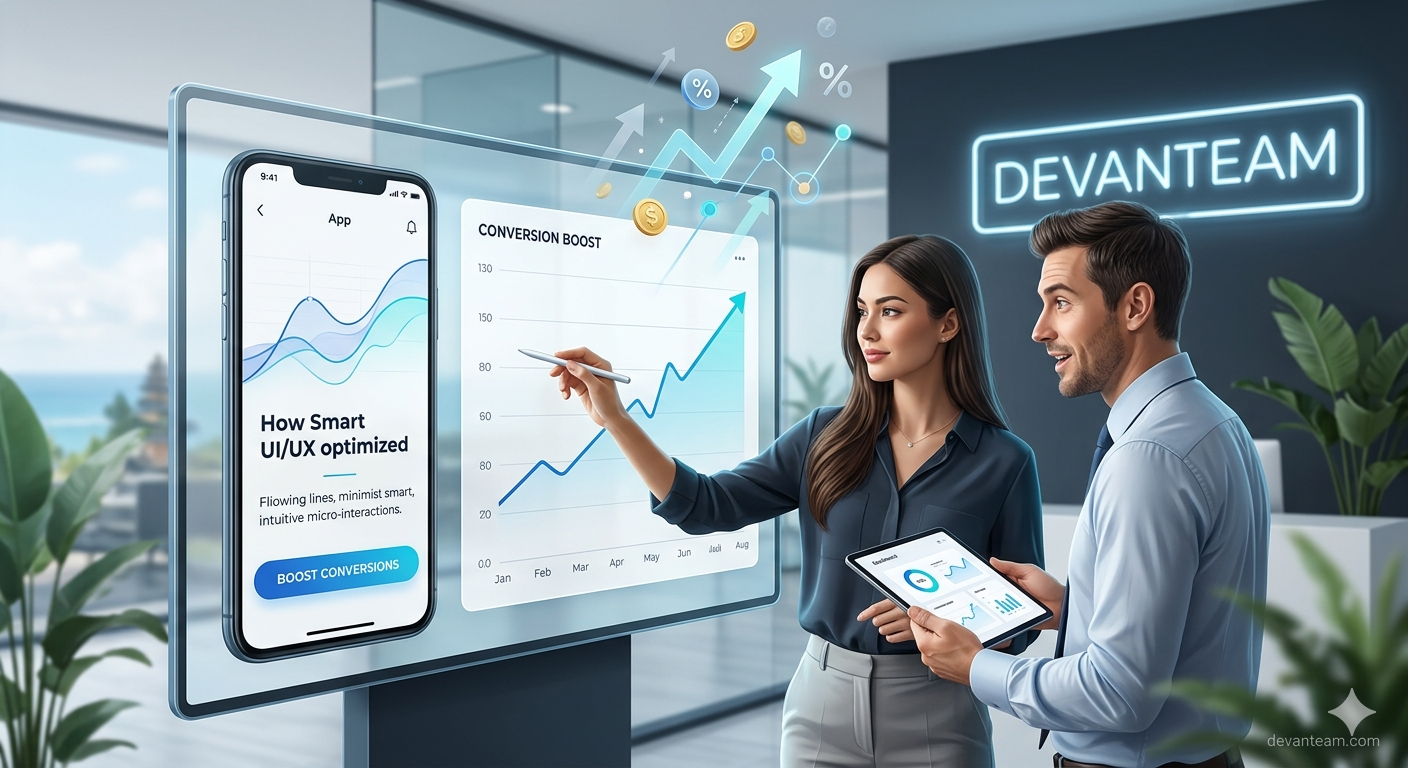
The digital landscape has reached a major turning point. Today, modern users are no longer captivated by cluttered visuals or complex transitions. They reject screens crammed with information. In an era where speed and seamless execution are paramount, user attention span has become the single most expensive asset on the internet.
For business leaders looking to build new software products or modernize existing digital platforms, the core challenge has fundamentally shifted: How do we present robust, feature-rich functionality without triggering user cognitive overload?
The answer lies in the strategic combination of two design methodologies dominating global product development today: Minimalist UI and Micro-Interactions.
1. Minimalist UI: Intentional Spatial Intelligence, Not Empty Space
A common misconception is treating minimalist design as a shortcut. However, in 2026, minimalism actually represents sophisticated structural engineering. Therefore, a successful interface always hides backend complexity. Specifically, it dynamically surfaces only the precise data points a user needs. As a result, users can focus entirely on their main task without distraction.
Here is why this trend is fundamentally critical to your business conversion rates:
- Eradicating Decision Paralysis: When users face excessive button choices, heavy banners, or blocky text blocks, they experience immediate cognitive overload. This friction forces hesitation, which directly translates to dropped funnels and increased churn rates.
- Achieving Instantaneous Load Times: From a hard engineering perspective, eliminating non-essential asset weight yields clean front-end codebases. With modern standard expectations, even a 1-second infrastructure lag causes major drops in conversion. Minimalist architecture ensures lightweight rendering.
- Laser-Focused Call-to-Actions (CTAs): By muting surrounding secondary graphics and using negative space intentionally, user eye paths naturally anchor directly onto conversion-critical components, such as your checkouts, subscription triggers, or scheduling links.
2. The Psychology of Micro-Interactions: Microscopic Feedback, Monumental Impact
If a clean minimalist layout acts as a well-designed, unobstructed digital storefront, then micro-interactions are the subtle human touches that make the space feel living, premium, and responsive. Micro-interactions are targeted, context-aware visual and haptic responses triggered by minute user activities.
Key practical executions driving user engagement right now include:
- Adaptive State Shifting: Subtle, highly fluid color shifts or depth elevation adjustments on primary buttons when cursor vectors approach or fingers touch them.
- Progressive Validation Bars: Elegant, physics-based confirmation tracks that assure the user their secure data is transmitting safely, replacing clunky modal alerts.
- Organic Screen Sweeps: Smooth card transitions that respond naturalistically to swipe speed, mimicking tangible real-world mechanics.
Psychologically, human beings crave confirmation of action. When software provides immediate, elegant, and low-latency feedback to every touch, users feel complete systemic control. This organic reassurance fosters a positive emotional connection with your product, inherently multiplying long-term user retention.
3. Connecting Modern Design Directly to Business ROI
Exceptional UI/UX development is far from an aesthetic vanity project—it is a measurable corporate investment. Deploying a structured minimalist interface backed by intentional micro-interactions yields quantifiable financial dividends:
- Elevated Transaction Throughput: Stripping navigation barriers transforms complex multi-step data collections or purchasing pathways into intuitive, friction-free flows, raising final conversion percentages.
- Reduced Customer Support Overheads: Highly intuitive software design functions as a self-explanatory guide. Because users naturally understand layouts, software companies see an immediate drop in customer support tickets and layout-related complaints.
- Augmented Brand Authority: A flawlessly executed, highly polished interface instantly communicates enterprise-grade credibility, instantly setting your digital presence apart from competitors utilizing rigid, outdated frameworks.
Conclusion: Simplicity is the Ultimate Premium Asset
To win market share in the current digital ecosystem, apps must focus on removing friction rather than expanding feature noise. Stripping away elements that do not actively serve the user while perfecting small, high-value interactions is the definite blueprint for digital success.
At Devanteam, we approach software development with a strict philosophy: every pixel must serve an economic purpose, and every line of code must defend system performance. We do not just build functional applications; we engineer highly performant, conversion-optimized digital experiences tailored to scale your enterprise business operations.
Ready to Modernize Your Digital Platform or Launch a High-Performance Product? Consult our expert team at Devanteam today.